I think there’s a broader question here from an evolutionary perspective. Humans are fundamentally tool users, and technology has been central to our development as a species. It’s possible that this evolutionary niche we’ve occupied will eventually reach its limits and contribute to our own downfall, but I’m not convinced AI is uniquely responsible. It’s part of a much longer trajectory of technological progress.
We’ve evolved to solve problems and use tools to make our lives easier. That doesn’t mean technological progress is inevitable, but these tendencies, combined with competition, make it difficult to imagine us ever really stopping. Even if we stopped today, who’s to say another generation of humans 10,000 years from now wouldn’t continue down the same path?
I don’t think this is exclusively about capitalism. Capitalism certainly incentivizes growth and reducing labor costs, but competition, greed, and the pursuit of technological advantages have existed under other economic systems too. That doesn’t diminish the legitimate concerns about how AI is being used against workers.
I also wonder whether our short lifespans make us particularly bad at considering the long-term consequences of our innovations. Who is going to sacrifice the opportunities of their own generation to prevent a possible catastrophe centuries from now, especially when there’s no guarantee it would stop technological progress?
I have a degree in psychology and particularly enjoyed evolutionary psychology, so I think it’s worth asking whether the deeper problem is our own nature, and whether our capacity for collective restraint can keep pace with our ability to innovate.
I know this raises more questions than it answers, but we’ve faced civilization-changing technologies before, from the printing press and electricity to nuclear weapons. AI won’t be the last. Perhaps the more important question is how we learn to manage these transformations when our tendency to create them seems so deeply rooted in who we are.


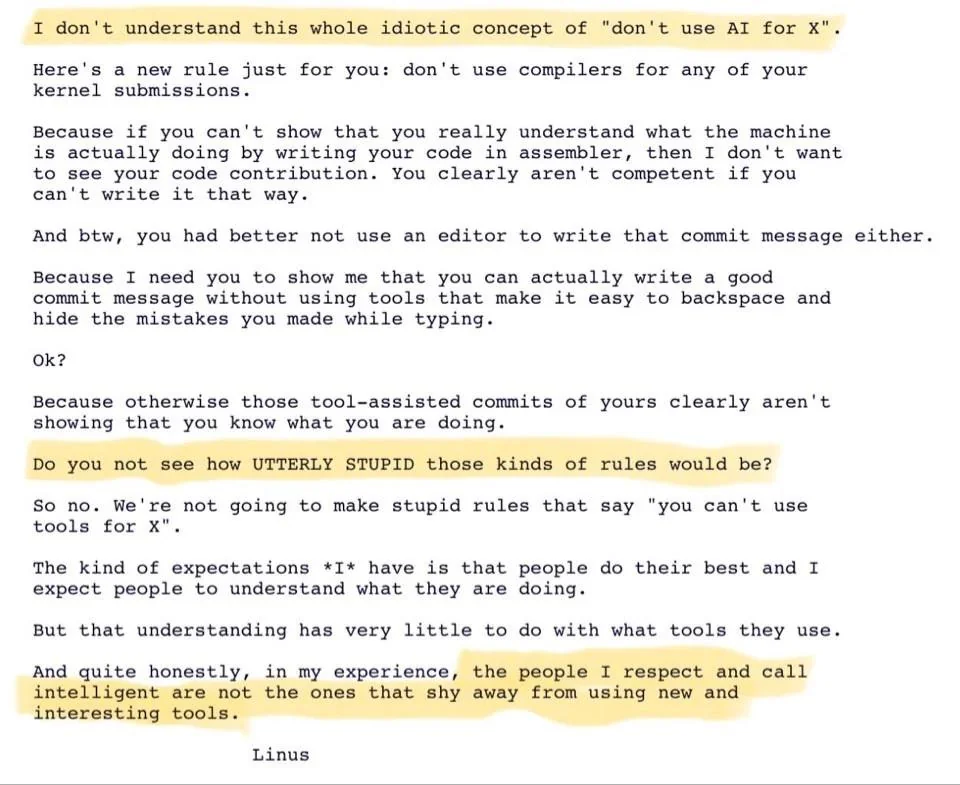
I think there’s a broader question here from an evolutionary perspective. Humans are fundamentally tool users, and technology has been central to our development as a species. It’s possible that this evolutionary niche we’ve occupied will eventually reach its limits and contribute to our own downfall, but I’m not convinced AI is uniquely responsible. It’s part of a much longer trajectory of technological progress.
We’ve evolved to solve problems and use tools to make our lives easier. That doesn’t mean technological progress is inevitable, but these tendencies, combined with competition, make it difficult to imagine us ever really stopping. Even if we stopped today, who’s to say another generation of humans 10,000 years from now wouldn’t continue down the same path?
I don’t think this is exclusively about capitalism. Capitalism certainly incentivizes growth and reducing labor costs, but competition, greed, and the pursuit of technological advantages have existed under other economic systems too. That doesn’t diminish the legitimate concerns about how AI is being used against workers.
I also wonder whether our short lifespans make us particularly bad at considering the long-term consequences of our innovations. Who is going to sacrifice the opportunities of their own generation to prevent a possible catastrophe centuries from now, especially when there’s no guarantee it would stop technological progress?
I have a degree in psychology and particularly enjoyed evolutionary psychology, so I think it’s worth asking whether the deeper problem is our own nature, and whether our capacity for collective restraint can keep pace with our ability to innovate.
I know this raises more questions than it answers, but we’ve faced civilization-changing technologies before, from the printing press and electricity to nuclear weapons. AI won’t be the last. Perhaps the more important question is how we learn to manage these transformations when our tendency to create them seems so deeply rooted in who we are.