

- cross-posted to:
- opensource@lemmy.ml
- cross-posted to:
- opensource@lemmy.ml
cross-posted from: https://lemmy.world/post/43147928
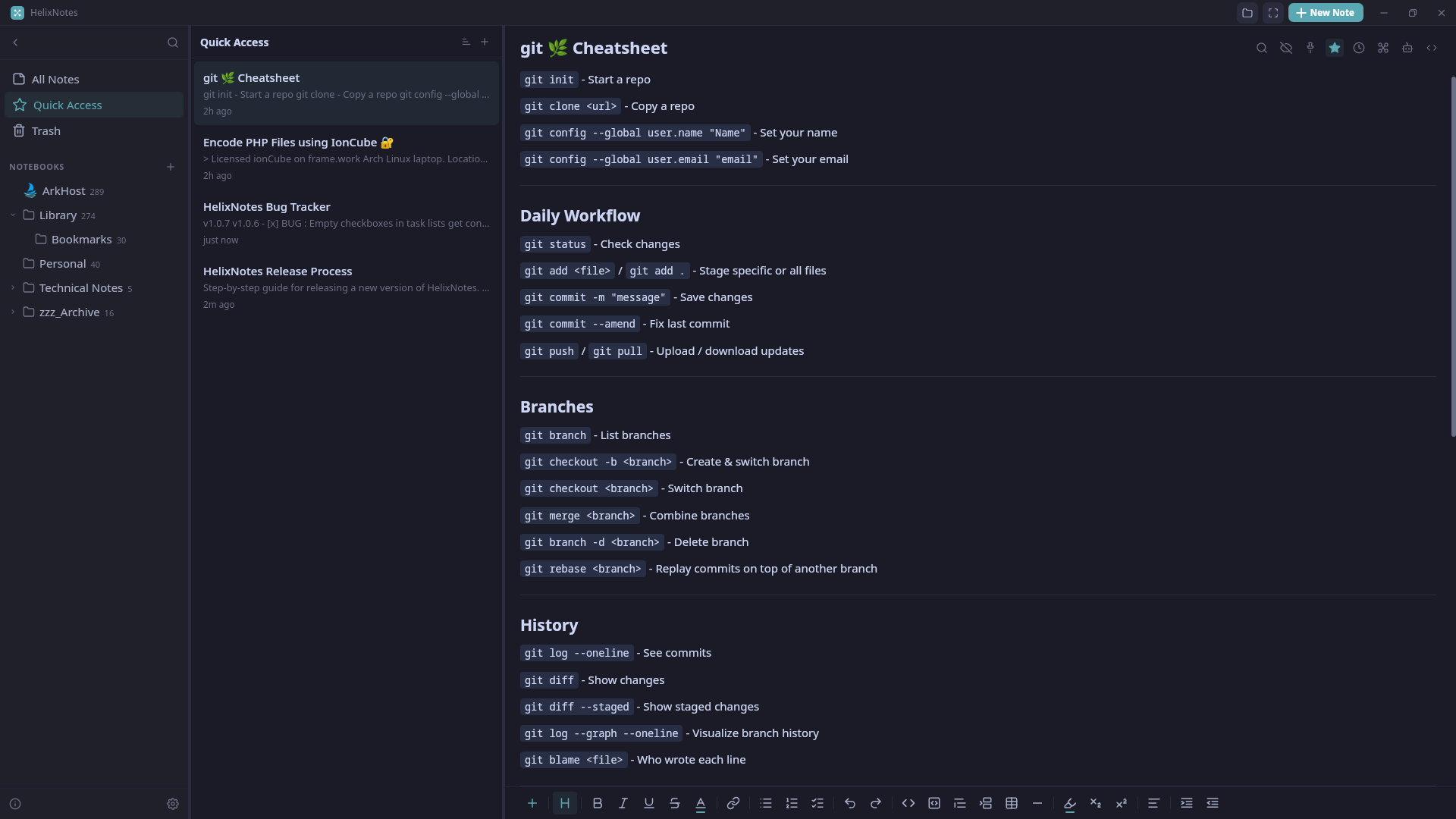
I built a note-taking app because the one I wanted didn’t exist. Clean UI, local .md files, no cloud, no account.
Built with Rust + Tauri 2.0 + SvelteKit. Full-text search powered by Tantivy. Graph view, AI writing tools (bring your own key), Obsidian import, version history.
Available for Linux (AppImage, APT, AUR), Windows, and macOS. Source: https://codeberg.org/ArkHost/HelixNotes
So, I recently abandoned Trilium, because it’s very half-assed.
It stores data in a database on your local file system, and you can export as markdown.
What do you mean “half-assed”? I manage very large collections of notes with it, in ways that no other PKMS can, just because none of them approach “note as data” (or “typed notes”) in a way that Trilium does.
My #1 criteria is for all my notes to remain consistent over time. If I create a note type for “Projects”, I want all notes representing a Project to have the same properties (start date, location, cost, …) at all time. Trilium has very neat concepts like Templates and Attributes Inheritance that make changes on the template be reflected on instances. That’s something even AnyType, Notion, Capacities, Logseq, Tena and others are struggling with. When your collection grows, so does your bookkeeping with those systems, and what should be a tool to help you get stuff done ends up giving you more work to do and holding you back. I beg to see a tool that helps my productivity so much.
I found it buggy and unfinished, plus a “That branch is unmaintained, use this fork” situation, so…nope.
Oh, so your experience with Trilium is at least a year old. In the meantime the original dev popped out of their hiatus to formally hand over the project (and the rights over the original repository) to the newly formed community, which has been very active (porting to typescript, internationalisation, porting of the UI to reactive components, full rewrite of the UI, new collections feature, new note types, new doc, new homepage, some LLM APIs, etc).
It’s still an opensource project run by volunteers on a best-effort basis, but it punches way above its weight-class.